
OFFICE: Payment Gateways
What is a Payment Gateway?
A Payment Gateway is an eCommerce service that processes payments for online and traditional brick and mortar stores. Payment Gateways facilitate these transactions by transferring key information between payment portals such as the platform and the front-end processor/bank.
You can configure a Payment Gateway to accept credit cards or, if eligible, you can also utilize ACH (bank transfer) via Stripe.
How do I connect my account to a Payment Gateway?
Navigate to Office > Gateways.

You'll see a selection of Payment Gateways to choose from to link. Click the Configure button of the Gateway of your choice to get started.
You can link as many Payment Gateways to your account as you'd like.
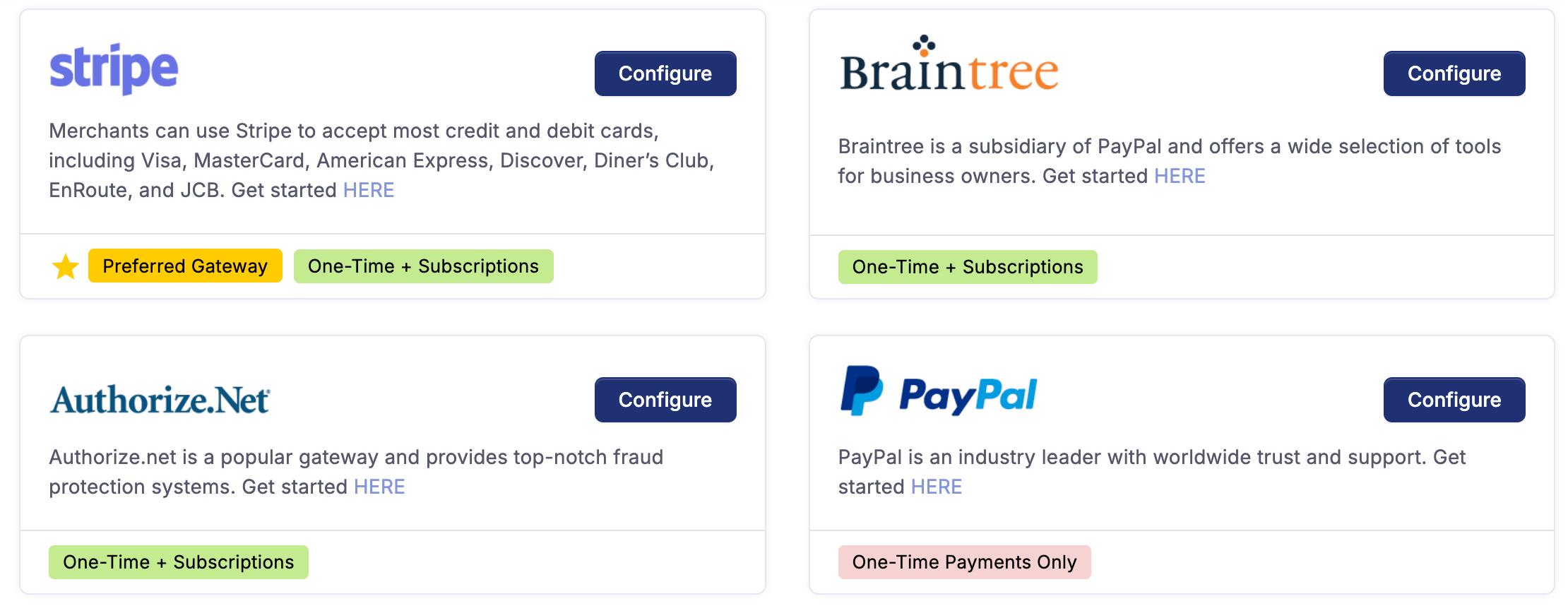
Since some Payment Gateways do not have the ability to handle Subscription Payments you'll be able to filter the Gateways that are shown. We plan to add additional Gateways so a search field is also available to use.

CLICK HERE to learn about Subscription Payments
While setting up a Gateway you can set it as a Preferred Gateway.

This will add an icon on a Payment Gateway card.
 Setting a Preferred Gateway ensures that there is never a scenario in which your Clients have to choose a Gateway while adding a Stored Payment Method in their My Office Dashboard.
CLICK HERE to learn about Stored Payment Information
CLICK HERE to learn about My Office Dashboard
TIP: You are required to have a Preferred Gateway. The first Payment Gateway that you configure will automatically be set as your Preferred Gateway.
How do I choose my Gateways?
Firstly, if you are interested in setting up Subscription Payments, you will need to use either Stripe, Braintree, or Authorize.net. The PayPal gateway cannot be used with Subscription Payments.
We have no special or promotional relationship with any of these Payment Gateways. We don't make money when you choose one or the other and we don't take any cut of the payments that your Clients make through our platform. We simply act as the tool for payment while the Payment Gateway handles all the actual processing and payouts.
Stripe & Stripe ACH
This is probably the best choice for most people. The application and setup are as easy or easier than anything else out there. It's easy to understand, the rates are industry standard, and it's trusted by some of the biggest companies on the planet.
Stripe can be used for both standard Invoice payments and Subscription Payments.
Stripe Payment options include:
- Credit Card
- Stripe Bank Account (ACH)
- Google Pay
- Cash App Pay
- Stripe Affirm (Buy Now, Pay Later)
- Afterpay / Clearpay (Buy Now, Pay Later)
- Apple Pay (Digital Wallet)
Braintree
Braintree is also a very good choice for a Payment Gateway. The application setup is fairly straightforward but can take a bit longer than Stripe. The rates are industry standard and it's also trusted by some of the biggest companies on the planet.
Braintree can be used for both standard Invoice payments and Subscription Payments.
Braintree Payment Options include:
- Credit Card
- Braintree Bank Account (ACH)
- Venmo
- Apple Pay
- PayPal
- Google Pay
Get Started with Braintree HERE
Authorize.net
PayPal
PayPal is an industry leader and most people already have a PayPal account. Depending on the region of the Client, a PayPal account may not be required and payment can be completed as a guest.
PayPal can ONLY be used for standard Invoice payments. PayPal cannot be used for Subscription Payments.
How do I set up Stripe as my Payment Gateway?
After you have your Stripe account created, set up, and verified to accept live payments, ensure you are logged in to your platform account and your Stripe account.
In your platform account, click the Configure button for Stripe.

You'll need to input the values for the Publishable Key and the Secret Key from your Stripe account.

After copying and pasting these values into each respective field, click the Save button.
In your Stripe dashboard look for the Developers menu item and then select API keys to locate the required information.
Please Note: When in stripe you will need to tick the option for 'Building your own integration' not 'providing this key to another website'.

You can use the same account (and the same keys) for both the Stripe and Stripe ACH Gateways. These will be treated as separate Gateways.
How do I set up Braintree as my Payment Gateway?
After you have your Braintree account created, set up, and verified to accept live payments, ensure you are logged into both your platform account and your Braintree account.
In your platform account, click the Configure button for Braintree.
 You'll need to input the values for the Merchant ID, Public Key, and Private Key.

After copying and pasting these values into each respective field, click the Save button.
To find your credentials in your Braintree dashboard, click the "Cog" icon and select API.
 You'll find the necessary values in the Keys tab.

How do I set up Authorize.net as my Payment Gateway?
Ensure that you are logged into your Authorize.net account. Then, be sure you are set up in LIVE mode

Then, you'll need to access your API Credentials & Keys through your Account tab.

You'll then want to copy the values

In your platform account, click the Configure button for Authorize.net.

You'll need to input the values for the API Login ID and Transaction Key, and you will need to set your Currency.
CLICK HERE to learn about Currencies

After copying and pasting these values into each respective field, click the Save button.
Before use, you will also need to change some of the options in your Authorize.net account. In the menu on your homepage, click Fraud Detection Suite listed under Tools.
 Scroll down to Transaction Settings, and click on Enhance AVS Handling Filter.

Change every option under General AVS Responses and Address and ZIP Code Responses to "Allow". If these restrictions are left in place, the Client can encounter errors while attempting to pay an Invoice.

Which currency does Authorize.net charge in?
Every charge now tells Authorize.net which currency it is in, taken from the Invoice itself. Before, the charge named no currency at all, so Authorize.net fell back on the one its own account settles in. A business whose account settled in one currency while it invoiced in another could have a Client charged the right number in the wrong currency, for example 244.20 euros against a 244.20 US dollar Invoice, with nothing on screen to say so. That silent mismatch is closed.
An Authorize.net account is opened for a single currency and cannot settle another, so the platform has to be told which one yours uses. Open your Authorize.net gateway and set Currency to the currency your account settles in.
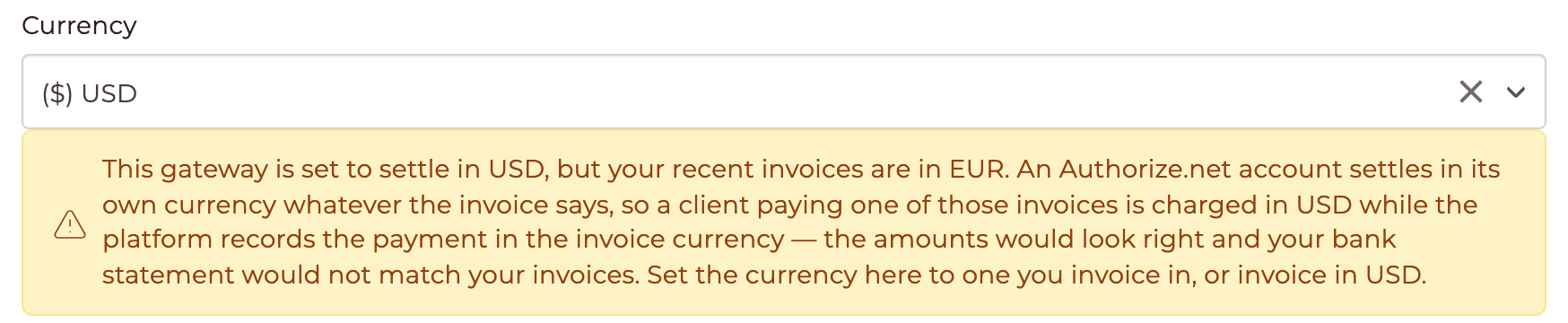
TIP: The warning on this screen compares the Currency you picked against the currencies your recent Invoices actually used, not against your default currency setting. A matching default is not evidence of a matching Invoice, and the businesses caught out are exactly the ones whose default looks fine.
What happens if my account cannot settle an Invoice's currency?
Four separate points catch the mismatch, so your Client is never charged in a currency the Invoice does not show.
- On the gateway screen. If you have not picked a Currency yet, you are asked for it. If you have, and your recent Invoices are in a different one, you get a warning naming both.
- When you save the gateway. The platform asks Authorize.net what your account really settles in, and refuses the save if your choice contradicts it. It refuses only on a definite contradiction: if Authorize.net cannot be reached, or names no currency, or you have not picked one, the save goes through, so an outage at Authorize.net never locks you out of your own settings.
- On the Invoice itself. Authorize.net is withheld from an Invoice it cannot settle, saved cards included. If that leaves no online way to pay, your Client sees a short explanation naming the Invoice's currency and asking them to contact you, rather than a blank payment screen. Turning Authorize.net on for an Invoice it cannot settle tells you at the moment you save that Invoice.
- On Subscriptions. Saving the gateway tells you how many active Subscriptions are priced in another currency. They keep their price and nothing is cancelled, but each one pauses at its next renewal instead of charging in the wrong currency. Reprice them, or connect an account that settles in the currency they use.
IMPORTANT: To clear a mismatch, either connect an Authorize.net account whose currency matches the one you invoice in, or invoice in the currency your account settles in. Businesses whose gateway and Invoice currencies already agree are unaffected and see no change.
What else can Authorize.net accept?
Card payments work as soon as your gateway is connected. Three further methods can be switched on from the gateway's Payment Methods panel, each running on your own Authorize.net account: PayPal, Google Pay and Bank Account (ACH). All three are off until you turn them on, so a gateway you already use keeps behaving exactly as it does today. Google Pay and Bank Account are covered below.
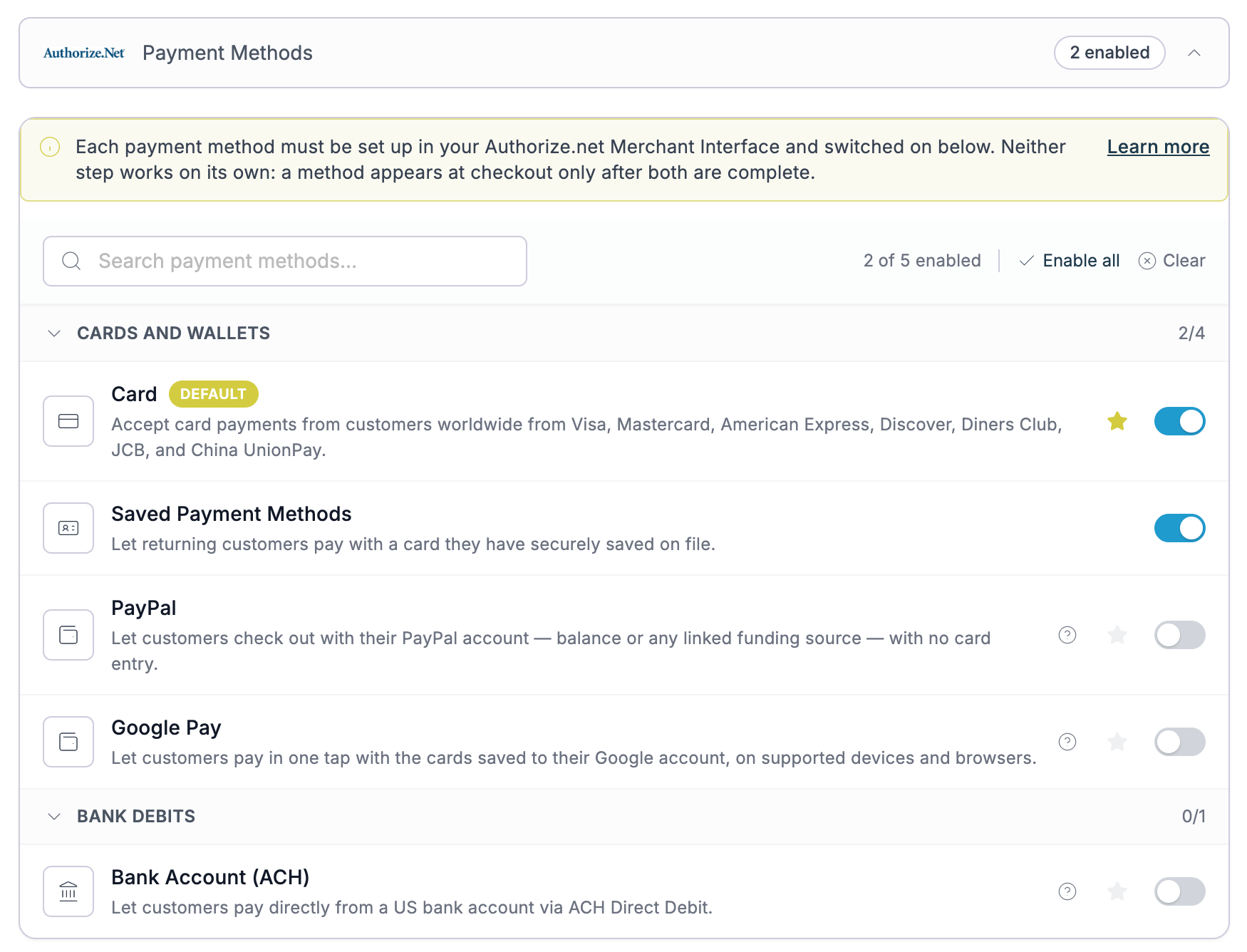
How do I enable Google Pay on Authorize.net?
Two things happen inside your Authorize.net account before the platform can take a Google Pay payment.
First, sign in to the Authorize.net Merchant Interface and go to Account > Digital Payment Solutions > Google Pay, where you turn it on and complete the KeySet ID exchange with Google. Second, for live payments, register as a merchant in the Google Pay & Wallet Console to get your Google Pay Merchant ID.
IMPORTANT: Google Pay is only supported on certain Authorize.net card processors: Chase Paymentech, FDC Nashville, Global Payments, NAB (EPX), TSYS, Worldpay/Vantiv Core and Elavon New. On any other processor Authorize.net cannot accept Google Pay, whatever you set here.
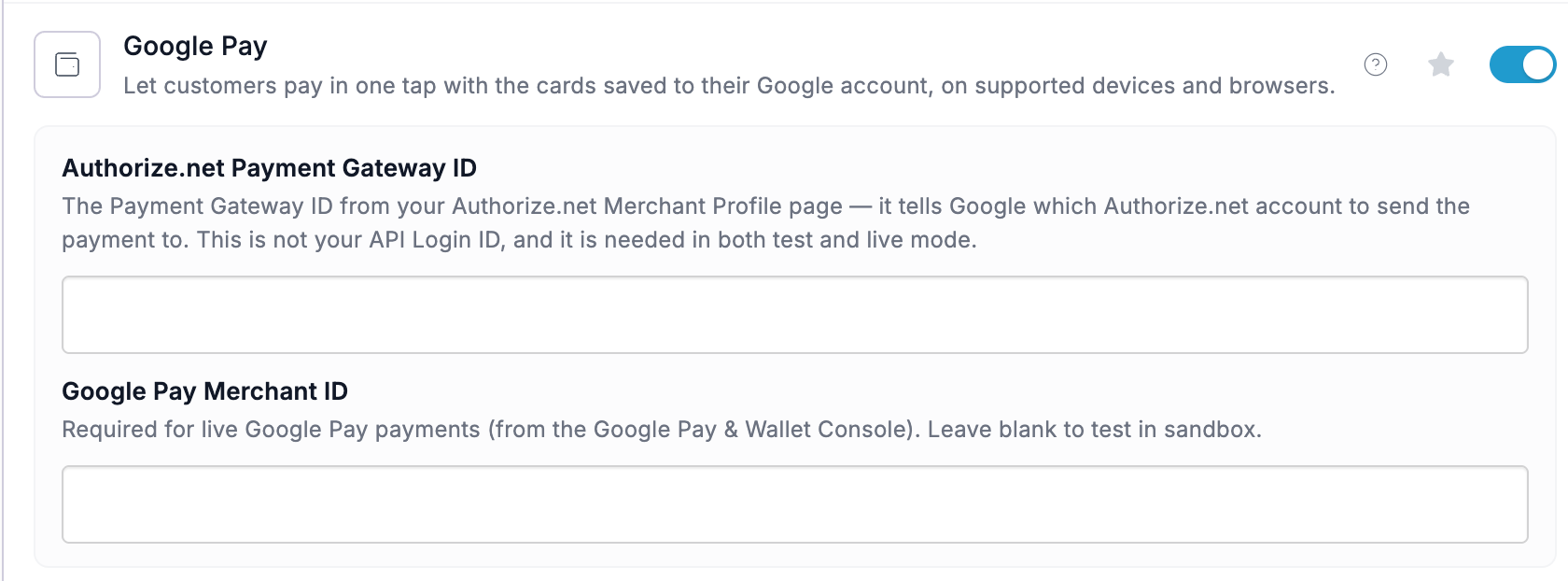
With that done, switch on Google Pay in your gateway's Payment Methods panel and supply two identifiers, both on the Google Pay row:
- Authorize.net Payment Gateway ID: from the Merchant Profile page of your Authorize.net Merchant Interface. It tells Google which Authorize.net account to send the payment to. This is not your API Login ID, and it is needed in both test and live mode.
- Google Pay Merchant ID: from the Google Pay & Wallet Console. Google issues it for production only, so leave it blank to test in sandbox. A live gateway will not switch Google Pay on without it.
At checkout, eligible Clients see Google's own button and pay in one tap. The button only appears on supported devices and browsers, so anyone who cannot use it simply pays another way.
TIP: Google Pay on Authorize.net is for one-off Invoice payments. It cannot be saved for Subscriptions or other recurring billing, because Google may return a single-use device token rather than a reusable card.
How do I enable Bank Account (ACH) on Authorize.net?
Bank Account (ACH) lets your US Clients pay straight from a bank account, which is worth having on larger Invoices where card fees add up. It runs on eCheck.Net.
eCheck.Net is applied for separately with Authorize.net rather than coming with your account: sign in to the Merchant Interface and check Account > Merchant Profile. eCheck debits US bank accounts only, so your Authorize.net account must settle in US dollars. An Authorize.net account settles in its own currency rather than the Invoice's, so an account in any other currency cannot offer bank payments at all.
When you save, we ask your Authorize.net account whether eCheck is enabled and will not turn this on until it is. If we cannot get an answer, we leave it off rather than guess: unlike a card, a bank payment your account cannot process fails only after your Client has typed in their routing and account numbers.
TIP: A bank payment is not instant. It is submitted and clears over the following business days, so the Invoice reads as processing until it settles and then updates to Paid on its own. Unlike Google Pay, a bank account can be saved and used for Subscriptions.
How do I set up PayPal as my Payment Gateway?
After you have your PayPal account created, set up, and verified to accept live payments, ensure you are logged in to your platform account and your PayPal account.
In your platform account, click the Configure button for PayPal.

You'll need to input the values for the API Username, API Password, and API Signature.

After copying and pasting these values into each respective field, click the Save button.
To find these values in your PayPal account, follow these screenshots to access the API credential. You are looking for the NVP/Soap/Classic API integration.


